The Hidden World Cup Problem With Julian Alvarez
One of Barcelona's most important transfer windows coincides with the World Cup. And World Cup summers are notorious for bad business deals. So how should Flick approach this? Full free analysis.

If you’re seeing this message, it means you’re entitled to a 20% discount for Dom’s Tactics Lab for one year, as a wee thank you for being an avid reader. Collect it on the link below! It expires tomorrow so be quick.
The domestic leagues are finally coming to a close but the excitement is somehow only beginning. And no, I don’t mean the partying for Culers, even though I wouldn’t blame you if you’re still doing a bit of that. I know I am. But no, what I actually meant was that the transfer window opens soon and the World Cup starts in, - checks notes -, a couple of weeks. Now, for most clubs these run as two completely separate events: recruitment on one side and tournament preparation on the other. For Barcelona, as well as a handful of other elite teams, however, this summer they are the same conversation and this overlap is creating a unique problem.
You see, and you may very well be aware of this, within Barcelona’s organisation, a clear internal belief has formed around one player and one player only: Julián Álvarez. For better or worse, and if you’ve followed my work for a while you know I’m leaning towards the latter, the phrase reportedly circulating among decision-makers is direct: ‘Julián is the signing no matter what.’ What makes this transfer interesting is the fact that Argentina are the defending world champions and among the tournament favourites. Which means, if they reach the final on July 19, Álvarez’s last competitive match before the new season could be about a week before LaLiga clubs begin their pre-seasons.
That is not primarily a fitness problem, even though fitness does have a say in it as well. Generally, a player returning from the World Cup can recover physically in a few weeks tops, provided they don’t go down injured. What cannot be recovered in two to three weeks, however, is something else entirely. Something specific to Flick’s system. Something we already documented in a different context and in a different analysis on Dom’s Tactics Lab a couple of weeks back. Have you already guessed what it is?
And it is what actually determines whether a major signing contributes from week one of the season or takes until October to look like the player Barcelona paid millions for.
Ready to dive in?
The Secret Calendar
Let’s for a moment pretend that our (not so) fictional player who reaches the World Cup final on July 19 joins their new club the following week. In that case, he arrives with approximately two to three weeks of integrated work before LaLiga starts in mid-August. All make sense so far? Now, compare that to the player signed in the normal summer window, joining pre-season from the first day of camp in late July. That guy gets six to seven weeks. The difference is far from marginal. The World Cup finalist gets roughly a third of the preparation time available to a teammate who spent the summer at home.
Obviously, not all Barcelona targets will reach the final. Even their reported priority target may not. There is simply no such guarantee in football. Now then, of course, for nations eliminated at the quarter-final stage the numbers do improve slightly. Those players return in early July and can access four to five weeks of pre-season. That’s better but still kind of compressed. And definitely still a different category from the signing who got eliminated in the group stage or was never at the tournament at all.
Back to the Catalans and the reigning champions of Spain, though. Barcelona’s summer context makes the compression particularly poorly timed. Robert Lewandowski is officially leaving. Andreas Christensen is also out of contract and Ronald Araujo not exactly certain to continue (or at least participate as much) either. Marcus Rashford could be returning to England after his loan, albeit with some chance of staying after all. In all the positions of (more or less) greatest need, in other words striker, centre-back and left winger, there are vacancies rather than transitions. Álvarez is the striker priority, Bastoni the centre-back priority at approximately €70 million while a left-winger profile is still to be confirmed but several names have been thrown in the ring.
Now, of those three positions, the striker is the most acute as it is the first choice starting position with no incumbent staying to cover the opening weeks while the new signing adjusts. When Lewandowski leaves, whoever replaces him needs to be operational from matchday one. Yes, Ferran Torres might still be there but reports differ on that as well. Either way, there is no version of this where Barcelona open the 2026/27 season with a striker vacancy and a patient six-week integration plan for a signing of the Alvarez magnitude.
This happens to every club with players at the World Cup and to every club signing World Cup participants, mind you. Manchester City, Bayern and Real Madrid have all managed it before, for example. And so have Barcelona. But most of the time it is manageable because most systems can absorb the compressed timeline without structural consequence.
Barcelona’s system or rather, Flick’s current system, is not most systems. And that… complicates things.
Let me explain.
Why This System Makes The Timing Problem Worse
Our substitution piece documented something specific about Flick’s system that becomes directly relevant here. Substitutions in conventional positional systems carry a relatively low integration cost: the incoming player knows where to stand, reads the general shape and adjusts. Simple, right? Well, it is but not for Barcelona.
Substitutions in Flick’s system carry a measurably higher cost because the press does not operate on positional principles we just briefly explained but rather on synchronised local cue reading, built through accumulated shared experience within that specific match. Sounds complex, I know. So go read that substitution piece.
In short, though, all of that means that a player entering at minute 65 arrives without the 65-minute live document the other 10 have been writing together. Needless to say, that produces an observable settling window of approximately 10-15 minutes minimum before the incoming player is reading the same cues at the same speed as those around them.
So it makes sense to conclude that an incoming transfer who misses pre-season faces the same problem at seasonal scale. And as you can imagine, it is worse in every dimension.
The substitute arrives at minute 65 with an architecture partially intact around them. The incoming transfer arrives on day one of the season with no architecture at all. Every pressing trigger, every line step and every cue about when to go and when to hold is new. None of it is automatic and all of it requires conscious processing that will, over weeks, gradually become implicit. But while it is still conscious, the player is doing two things simultaneously: executing decisions and learning the system they are executing them inside. That dual load reduces the quality of both. Cognitive integration under live competitive pressure works that way regardless of the quality of the player experiencing it.
This is the point where the World Cup becomes something more than a scheduling inconvenience.
An existing Barcelona player returning from the tournament faces a milder version of this problem. Pedri, Cubarsí, Koundé and Raphinha, for example, are rebuilding familiarity with a system they have spent two seasons constructing. The architecture weakens temporarily, sure, but it won’t just disappear like that. Years of accumulated cue-reading do not vanish in six weeks and pre-season work accelerates the rebuild anyway. Their re-integration is a shortening process, not a construction one.
Some will point to Álvarez’s time under Guardiola at Manchester City or even Atletico Madrid under Diego Simeone as evidence that this overstates the problem. Two seasons in one of the most cognitively demanding pressing systems in world football is not nothing. He is not a player discovering what organised collective pressing demands for the first time, let’s make that clear from the get-go.
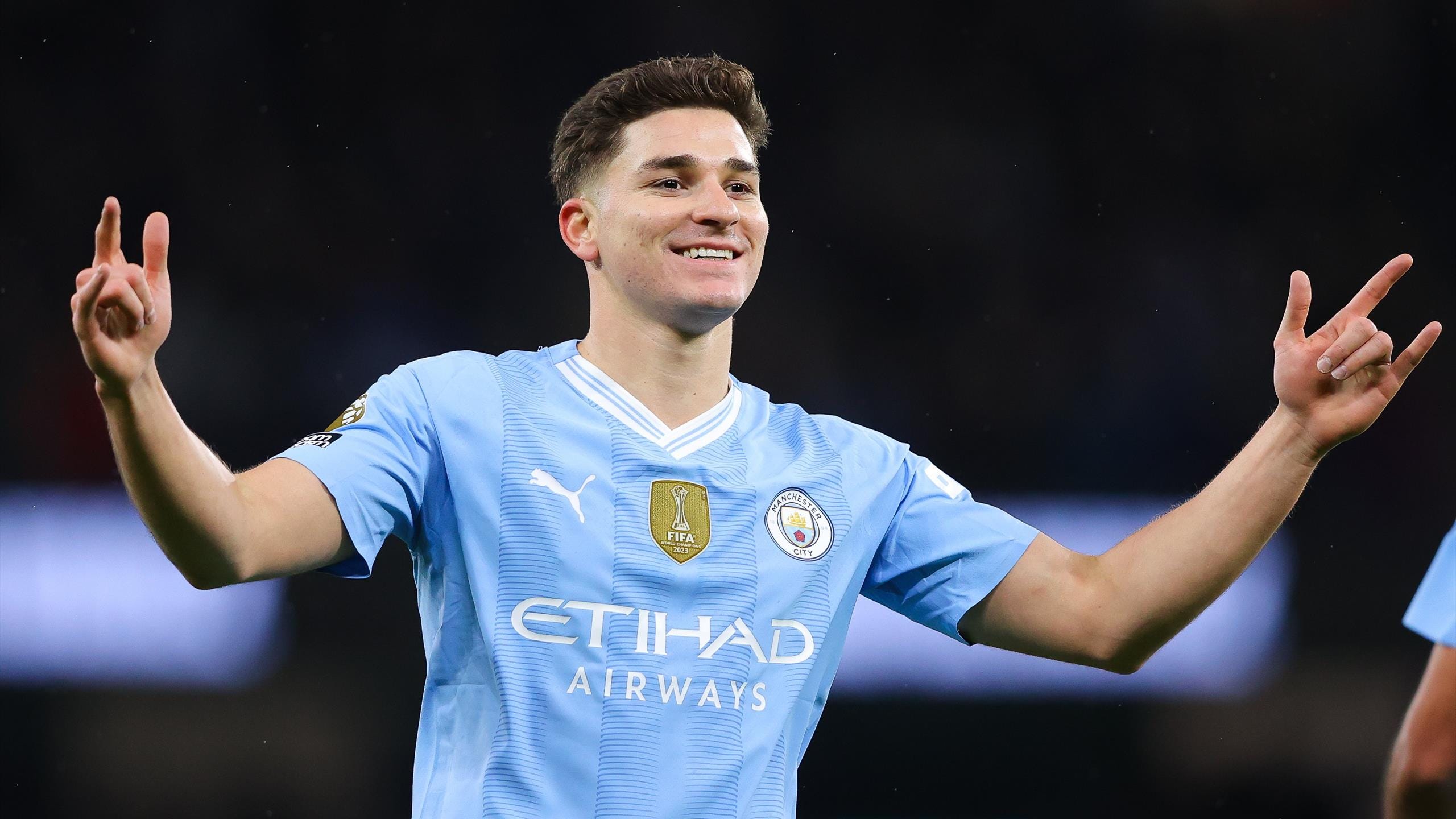
What that background does not provide is system-specific familiarity with Flick’s version of it. Guardiola’s pressing triggers are not Flick’s pressing triggers. The cue that tells a City player when to go is not the cue that tells a Barcelona player when the line steps. The automaticity Álvarez has built through those two seasons is real but it is also the wrong automaticity for this specific system. A player with deeply ingrained responses from a different sophisticated press does not recalibrate faster than a player arriving from a simpler one. I mentioned Pep and not Cholo here because the latter is in a completely different realm of tactics and defending. So in some respects, the recalibration is even harder. But I digress.
Álvarez, if he arrives, will arrive having spent six weeks ingraining Scaloni’s system. He will have been operating under a different coach, responding to different pressing triggers, reading different cues, building movement habits that are specifically Argentina’s and not Barcelona’s. Argentina’s press under Scaloni is reactive rather than systematised, triggered by opposition errors and individual reads rather than coordinated cue sequences across a collective unit. Barcelona’s is the opposite: cue-triggered, synchronised, with the defensive line stepping as one body because one player has read the ball carrier’s body shape and the others have learned to follow that specific trigger. These are not two versions of the same cognitive task.
Of course, I’m not saying he must consciously unlearn any of it. But the automatic processing that Flick’s system depends on does not accommodate competing automatic responses easily. The recalibration takes time and that time comes directly out of the most important weeks of the season. The same goes for Diego Simeone’s system, which must be ingrained in Alvarez’s brain by now.
This is not speculation, by the way. Wegner’s work on transactive memory, the shared cognitive architecture teams build through collective experience, and Huckman and Pisano’s research on how performance degrades when that architecture is disrupted both provide the mechanism. DTL’s substitution piece built the full case so feel free to go back and check it out. No, seriously, it’s worth it; I promise. The point here is narrower, though: an incoming transfer is being absent from an existing architecture while it is being constructed around them.
And the funny thing is, Flick’s system is the ‘problem’ here. The calendar, while certainly merciless and far too busy at times, simply determines how much time is available to solve it.
What This Means Practically
The most immediately actionable point is transfer timing. Most recruitment coverage treats it as commercial and logistical, from contract length, fee structure and all the way to announcement windows. For a signing entering Flick’s system from the World Cup, however, timing is something else entirely: it is training time. A deal agreed before the tournament begins, for example, would, in theory, allow Álvarez to train at Barcelona much earlier and is certainly meaningfully better than a deal finalised after the final. Every week of June integration inside the system reduces the adjustment period that would otherwise fall across the opening months of the season.
Whether that is available depends on Atletico Madrid’s cooperation, which reported negotiations suggest is far from guaranteed. I mean, let’s be real, ‘far from guaranteed’ does not begin to explain the difficulty of this deal, even if we turn a blind eye on Barcelona’s finances. And even if an early deal happens, Álvarez still returns from the World Cup having spent six weeks operating inside Scaloni’s system. June integration is better than nothing but we also can’t pretend it’s a substitute for a connected pre-season immediately before the season begins.
And besides, how realistic would it be to expect a June signing to go and train with Flick in that same month already? That is just not possible at all, both logistically and considering the transfer window opening dates. But I wanted to mention it as the ideal, albeit completely fictional, solution nonetheless.

The integration timeline also has direct consequences for how Barcelona open 2026/27. If Álvarez arrives two to three weeks before the season and needs time to reach full operational status, those opening matches require a striker who is already inside the system. Ferran Torres is the obvious candidate here. Either way, whoever is making squad decisions for the first month of the season needs to be planning for this scenario now, not after the World Cup final.
The point most worth sitting with, though, is how to read the opening weeks of Álvarez’s Barcelona career if this plays out as described. If he starts slowly, not physically slow and not low on confidence, but slightly late in pressing decisions, a touch displaced in his receiving positions and not quite on the timing of line steps he has not yet internalised, don’t be immediately alarmed.
Should that happen, now we know it would simply be the integration cost made visible. Read those weeks through the lens of cognitive adjustment rather than performance verdict and you will see a more accurate picture of what Barcelona actually have.
And a more patient one.
Final Remarks
Every Barcelona fan watching Argentina this summer will be watching Álvarez. The goals, the movement, the quality. We will no doubt be watching whether he justifies what Barcelona are expected to pay for him. But there is a second thing worth watching alongside it as well.
Watch how he moves inside Scaloni’s system, the triggers he responds to or where he positions himself in transitions, how early he reads the press, what the movement patterns look like after six weeks of tournament football under a coach whose system is not Flick’s. Because when Álvarez arrives in Barcelona, if he arrives, he will need to replace all of that with something different. And the system he is joining is specifically one that cannot fully trust a new player until that replacement is complete.
The World Cup is (more or less) the right stage to judge his quality in the upcoming weeks. But don’t treat it as a preview of what his first months at Barcelona will look like. For any other club it might be close enough. For this one, the tournament and the integration are entirely separate problems and one of them ends only when the other begins.
For Barcelona’s most important (fictional) signing this summer, the World Cup is the last obstacle before integration can begin.